
Article: The Quiet Strength of Organic NSW Merino DK
The Quiet Strength of Organic NSW Merino DK
There is something quietly reassuring about working with merino wool.
It is familiar, widely loved, and often the starting point for many knitting journeys. And yet, when you take a closer look, it reveals a surprising depth — in how it is processed, how it behaves, and how it feels once it becomes part of a finished garment.
Our Organic NSW Merino DK is one of those yarns that may seem simple at first glance, but carries a thoughtful set of decisions behind it. From fibre to spinning method, each step shapes the experience of knitting with it.
We wanted to take a moment to share that story with you.
Is NSW Merino from Australia?
This is one of the questions we hear quite often.
The merino fibre itself comes from sheep raised in South America — a region known for producing fine, soft wool. From there, the fibre is processed and spun before arriving with us in Edinburgh.
Here is where it becomes part of Zakami.
Each skein is dyed slowly by hand in small batches, allowing the colours to develop depth and subtle variation. So while the fibre has its origins in Australia, the yarn itself is shaped by our work, our colours, and our way of doing things.
Why We Chose Non-Superwash Merino
One of the most important decisions we made as a brand was to step away from superwash wool and focus on non-superwash fibres instead.
To understand why, it helps to look at wool in its natural state.
Wool fibres are made from keratin and covered in tiny overlapping scales. These scales are what give wool its elasticity, resilience, and memory. They also allow the fibres to gently interlock, helping garments hold their shape over time.
Superwash wool is created through a treatment process that changes this structure.
The fibres are first treated with chlorine to remove the natural scales. They are then coated with a synthetic polymer resin — often polyamide-epichlorohydrin (Hercosett) — forming a very thin layer around the fibre. This smooths the surface and prevents the fibres from interlocking, which is what makes the yarn machine-washable.
We completely understand why many knitters choose superwash yarn. Easy care can be very practical, especially for everyday garments.
At the same time, the process changes the nature of the fibre.
Superwash yarns tend to drape more and feel smoother, but they often lose some of the structure and elasticity that wool naturally provides. Non-superwash wool, on the other hand, retains those qualities — allowing stitches to settle, garments to hold their shape, and fabric to feel more alive over time.
There are also environmental considerations. Traditional superwash treatments require additional water, energy, and chemical processing, and finished garments may release microplastics during washing.
For us, choosing non-superwash wool felt like a way to stay closer to the material itself.
It was a significant change for Zakami, and we are deeply grateful to everyone who stayed with us through that transition and continues to support our work with natural fibres.
Woollen vs Worsted — Why Spinning Matters
Another important part of the story lies in how the yarn is spun.
You may have come across the terms woollen and worsted before. These don’t refer to yarn weight, but to two different spinning systems.
In woollen spinning, fibres are carded and arranged in many directions, trapping air within the yarn. This creates a fabric that is light, airy, and very warm.
In worsted spinning, fibres are combed and carefully aligned before spinning. The result is a smoother, denser yarn with excellent stitch definition.
Our Organic NSW Merino DK is spun using the worsted method.
This gives the yarn a balanced structure — smooth enough for clear stitches, yet still soft and comfortable against the skin. It is particularly well suited to garments where shape and definition matter.
What It Feels Like to Knit With It
The difference becomes noticeable once you start knitting.
Stitches sit neatly next to each other.
Cables hold their shape.
Ribbing gently springs back.
The fabric feels soft, but not overly drapey. It has enough structure to support garments that are worn often and expected to last.
It is the kind of yarn that supports a pattern rather than competing with it.
Here's some Pattern Ideas for Organic Merino DK
Dyed and Undyed — Two Ways to Experience the Yarn
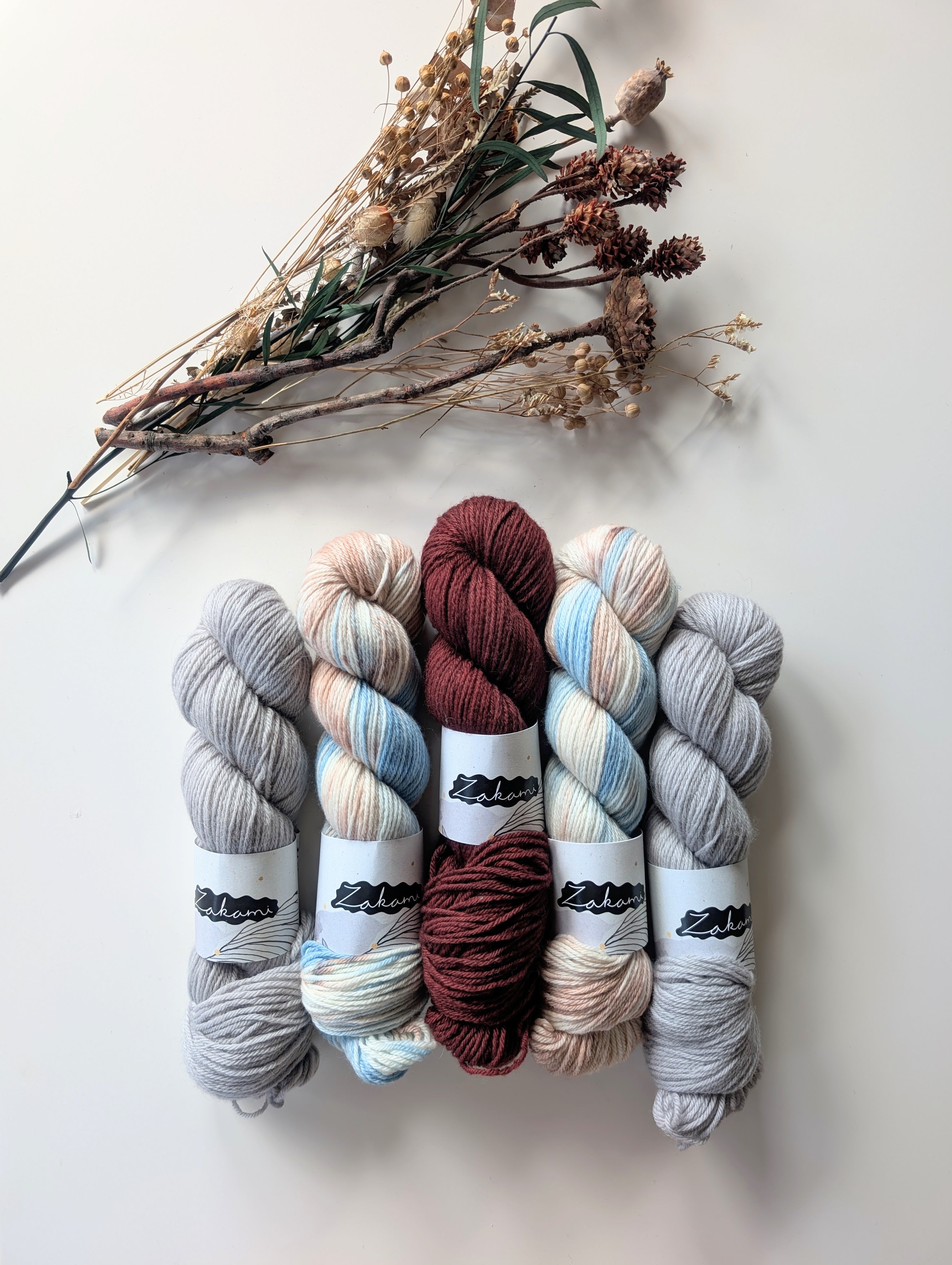
Most of our Organic NSW Merino DK is hand-dyed in Edinburgh, creating colours that feel soft, layered, and slightly tonal.
At the same time, we also offer this yarn undyed.
Undyed skeins allow you to experience the fibre in its simplest form — quiet, natural, and beautifully understated. They can also be paired with dyed skeins to create gentle contrast in multicoloured projects.
For many knitters, this becomes a way to explore colour and texture in a more personal and intuitive way.
A Gentle Invitation
A new project often begins quietly.
A saved pattern.
A colour that catches your eye.
A skein you keep coming back to.
Our Organic NSW Merino DK was created for those kinds of projects — pieces you enjoy making, and return to wearing again and again.
If you are thinking about your next cast-on, you can explore the available colours, as well as the undyed options, on our website.
And if you are unsure where to begin, we are always here to help.